
The terrorists have been identified as Raqib Ahmad Sheikh, a resident of Shiganpora in Kulgam, and Pakistani nationals Waleed and Numan, a police spokesman said.
'We think Pakistan has moved decisively against terrorists that threaten Pakistan internally, but still needs to devote attention to those that represent a threat to their neighbours.'
'The hardliners in Delhi are in for a big disappointment,' predicts Ambassador M K Bhadrakumar.

Stepping up its attempts to internationalise the Kashmir issue, Pakistan has written to the UN chief on the security situation along the LoC and the International Border with India and sought the world body's intervention in resolving the issue.

Xi will attend the second informal meeting with Modi at Mahabalipuram near Chennai from October 11 to 12 and pay a state visit to Nepal on October 13, Foreign Ministry spokesperson Hua Chunying announced on Wednesday.
'It seems likely that the February 2019 crisis is over.'

But the US will sell F-16 aircraft to Pakistan to fight 'terrorists.'
India has said that Pakistan created the conditions for cancellation of the talks -- due to issuing of postage stamps glorifying terrorists and brutal killing of its three security personnel.
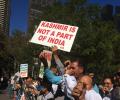
According to the cable, Sattar reacted positively to the idea of involving Kashmiris.

'In a relationship that does not permit cricket, how can the prime ministers embrace and send a false message,' asks Ambassador T P Sreenivasan.

The outcome of the Bangkok NSA-level talks underscores that Pakistan has got exactly what it wanted -- talks at different levels, talks on Kashmir, talks on mutual concerns regarding terrorism, talks on ceasefire on the border. What if any has been India's gains remains unexplained, says Ambassador M K Bhadrakumar.

The Opposition in the Pakistan Punjab assembly on Tuesday staged a walkout to protest against Saeed's detention.

Sayeed said he was disappointed over the abrupt cancellation of talks but hoped that break would be "temporary".
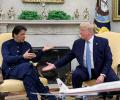
'Pakistan is determined to garner the peace dividends.' 'On the diplomatic front, this will be, principally, in terms of a revival of Pakistan's relations with the US,' notes Ambassador M K Bhadrakumar.

Swaraj also said that Pak cannot take Kashmir to the ICJ.

Pakistan has got the message that the Modi regime in New Delhi has brought in a new language of dialogue with Islamabad, sources well informed about the preparation for the Kathmandu meeting tell Sheela Bhatt/Rediff.com

'I believe Modi mentioned Balochistan only to embarrass Pakistan and also divert attention toward the situation in Kashmir.' 'I think from now on, India intends to raise Balochistan whenever Pakistan brings up Kashmir or upsets them on the issue of terrorism.' 'Balochistan is the least developed of Pakistan's four provinces. It is the least educated and least economically developed. People are agitated that a region so rich in mineral resources and a sea-port is still so poor.' Baloch political analyst Malik Siraj Akbar on why the province wants freedom from Pakistan.
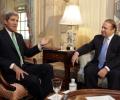
Pakistan Prime Minister Nawaz Sharif continues his exhortation for US mediation in Kashmir, and harks back to his meeting with former Prime Minister Atal Bihari Vajpayee when the latter had agreed to a resolution of Kashmir imbroglio; senior us officials assert there is 'absolutely no change in us policy' that Kashmir has to be resolved bilaterally. Aziz Haniffa reports.

A tense standoff continued in Pakistan on Saturday as overnight talks between the government and protesters demanding Prime Minister Nawaz Sharif's resignation made little headway in breaking the political logjam.
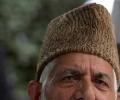
In a surprise snub to Pakistan, hardline Hurriyat leader Syed Ali Shah Geelani decided to "boycott" the Eid Milan being hosted by Pakistan high commissioner Abdul Basit in Delhi on July 21, making it the first time that he has turned down such an invite.

Aziz also attended a dinner where he exchanged pleasantries with PM Modi.

'Clearly, the warming of ties can be a 'win-win' for India and China,' says Ambassador M K Bhadrakumar.

"First of all I would like to welcome it. I am not one of the cynics who always put ifs and buts," Kasuri told exclusively to ANI.

Pakistan's last military parade was held on March 23, 2008.

With less than 24 hours to go for Pakistan NSA Sartaj Aziz's arrival in New Delhi, External Affairs Minister Sushma Swaraj told a press conference that Pakistan had only till Saturday night to give a categorical assurance on two issues.

The cascade of cordiality on both sides after the Modi-Sharif handshake in Paris was preceded by much planning and even goading from UK, US and Germany.

'The public has unfair expectations from Mrs Swaraj who is in Islamabad primarily for the Heart of Asia Conference. To restore India's position among stakeholders on Afghanistan is a fair one but to expect her to do more on the Indo-Pak front without requisite preparatory work is unrealistic.'

The Congress on Monday accused the ruling National Democratic Alliance of making a "fundamental departure" in New Delhi's position on Indo-Pak ties and of 'disrespecting' Parliament, as the government assured that External Affairs Minister Sushma Swaraj will make a statement on the issue later this week.

'The two NSAs, who have been mandated to address mutual concerns on terrorism, will need to devise credible and irreversible measures to see that the likes of Hafiz Saeed and Masood Azhar do not ever get a free hand to run riot again,' says Ambassador G Parthasarathy, India's former high commissioner in Pakistan.

When asked if the Indian investigating agency would be allowed to visit Pakistan, Basit said that 'the whole investigation is not about reciprocity in view'.

Ahead of Prime Minister Nawaz Sharif's visit to United States in October, the United States is negotiating a pact on the new limits on Pakistan's nuclear weapons and delivery systems, a deal which might lead to an agreement that is similar to the Indo-US civil nuclear deal, according to a media report.
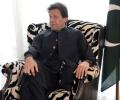
"The world's eye is on Kashmir and on Pakistan...I will be the ambassador who raises Kashmir's voice at every international forum," he said.
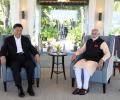
'China physically occupies about 45,000 sq km of J&K as claimed by India, including 3,000 sq km captured in the 1962 War and never returned; and 5,180 sq km ceded to China by Pakistan in 1963.' 'It is hard to justify remaining silent about the return of China occupied Ladakh,' observes Ajay Shukla.

New Delhi remains a priggish suitor to Washington's overtures, but it has begun appreciating potential tech benefits to ties with the US.
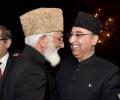
'The Modi government has turned the basic fundamentals of its Pakistan policy on its head.' 'It means an admission that its hands-off-Hurriyat policy was flawed and it is ready to engage with Pakistan without minding if the Kashmiri separatists talked to the Pakistani government,' says Rajeev Sharma.

'Civilian casualties are something that could change the mood overnight, and therefore should be avoided by every means.'

Tillerson said China's behaviour and action is "posing a challenge to the rules-based international order".
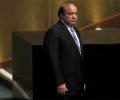
'Indian diplomacy is once again being saddled with the heavy burden of a Pakistan-centric foreign policy. It is something grossly unfair at a crucial juncture in India's trajectory as an emerging power on the global stage,' argues Ambassador M K Bhadrakumar.

"When we asked the US, to play facilitating role...Why do we ask? Simply because we are not engaging bilaterally," he said.

'If India is already involved in helping the insurgents in Baluchistan and Karachi, as Pakistan says, it is but one step for New Delhi to bring Dawood or Hafiz Saeed into its sights,' says Amulya Ganguli.
 © 2026 Rediff.com - Advertise with us - Disclaimer - Privacy Policy - Sitemap - Feedback - About us - Terms of use - Grievances